13/09/2012
Motorsport Zorce Issue
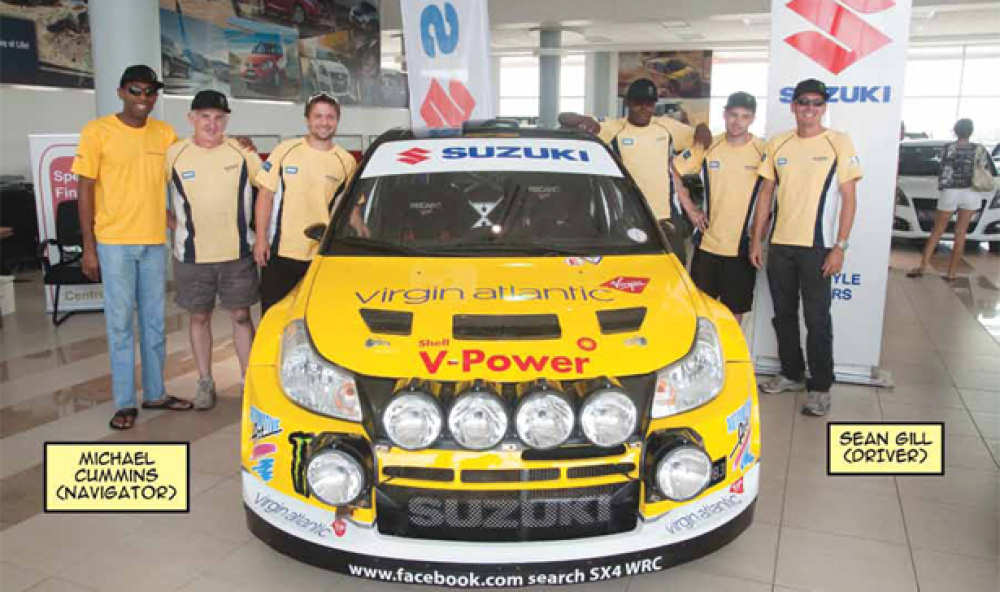
Suzuki SX4: Zorce Issue Team

We managed to sneak our way into the garage at Lifestyle Motors two days before the start of Rally Trinidad 2012 to get up close and personal with the Suzuki SX4 WRC and the men who created and continue to work on this amazing machine. With the cancellation of the Suzuki Sport WRC programme, this project almost didn’t make it until Simpson Motors decided to have development continue in the hopes of having a real WRC-class contender. After 18 months of fabrication and a year or two of teething, the Suzuki SX4 WRC is finally showing its true colours with driver Sean Gill securing enough seat time to be comfortable at race pace. There is no doubt that this car has what it takes to win a major Caribbean rally in the near future.
This is an authentic Suzuki SX4 WRC car, which uses the Suzuki J20A base engine from the Suzuki Grand Vitara. Now it’s been turbocharged and has had a few interesting things done to it. According to WRC rules, teams must use a standard head and block but internals can also be changed along with forced induction. Interestingly, the water pump is the same one used in the standard road car. The compact and lightweight McLaren electronics alternator has been relocated to the front, as the engine has been tilted back at a 30-degree angle. This was done to position the SX4’s centre of gravity further back and lower down.
The SX4’s engine is also fitted with an anti-lag system to keep the turbo spooling even when off the throttle. The system can be switched off when cruising. The heat shield for the turbo and exhaust manifold is made from a material known as Inconel, which is a nickel-chromium based super-alloy capable of withstanding extremely high temperatures and was originally developed for use on NASA’s space shuttle. Turbo speed (and thereby boost) is modulated using a wastegate and is actually measured on the SX4, averaging around 140,000rpm. Because these turbos are meant to perform with a 34mm restrictor, they are designed to spool very easily. The turbines feature an aspect ratio that is almost the opposite of a turbo for a regular road car. The main objective is to have maximum airflow through the restrictor at the lowest rpm in order to produce a lot of torque
Redline is set at 7500rpm and there is a constant flow of power from 3000rpm all the way up. With only 20hp difference from 3000 to the power peak at 5000, then at the 7500rpm limit, this engine is very flexible. In the lower rpm range, the torque output peaks around 800Nm or 590ft-lb and the overall curve is very flat. This explains the SX4’s tenacious launch from standstill and ability to quickly recover from minor mistakes. The engine maps from tarmac to gravel are not vastly different, except for minor throttle mapping changes and small tweaks in the directness of the engine’s response since the drivers typically prefer to modulate power using the accelerator pedal. The gearbox system uses paddle shifters mounted behind the steering wheel and can shift up or down through gears, as well as skip gears as needed. The team also carries two sets of gear ratios.
French BOS dampers, popular with factory teams like Mitsubishi Ralliart, Subaru and Citroën Sport are used. The major difference between these and road car dampers is that they feature a mechanical rebound control system, which monitors each wheel’s load. Once there is no load it opens the droop control of the damper to maximise the time that the wheel is in contact with the ground and therefore provides more constant forward motion. Without this the car would feel very bouncy, even with dampers that have adjustable settings.
There are two information screens in the SX4: one each for driver and navigator. The driver’s screen shows the gear, engine speed, oil temperature and other vitals. The navigator’s screen has a lot more pages for the management of the engine, chassis, pneumatic system, battery charging and CAN systems. This allows the team to help the driver and navi monitor, diagnose and solve problems during service intervals. The system records all data to memory cards that the engineers can analyse between stages. Essentially, this means that they will be one stage behind with each batch of data but it still helps if the team is tracking any known or developing issues; they can then plan the requirements of the next service in a rally. Magneti Marelli Electronic Systems control the chassis, engine and electrical power distribution. The electrical system monitors the temperature of the circuits and the amount of current passing through them. It also eliminates the traditional fuses and breakers and is programmable to do things like switch off or keep trying to restart the car once it has cooled down.
The SX4 features a lot of high-strength, lowweight carbon fibre pieces and the mandatory FIA-spec roll cage. Although Caribbean rules do not require side impact beams, the engineers felt that it would be safer to have them. The car is around 30kg underweight and relies on lead weights to meet requirements. The driver and navigator both use cool shirts with a dedicated cooling system. A fuel cell is used to store racing gas and relies on a lifter pump and two highpressure fuel pumps with one as an auxiliary pump that can be used should the primary pump fail or become inefficient. It’s not required but with the weight savings, the team can now afford to add redundant systems to ensure reliability.
The team took away large volumes of data from the 2011 Caribbean rally season and used their analysis to tailor this year’s setup, along with a few engine updates for 2012. The unfortunate gearbox problem in Rally Jamaica 2011 seemed to be a random one, as the gearbox was nowhere near its life expectancy. The car continued the rally without the use of third and fourth gear on the first day, costing around 30 seconds of stage time.
In the end, driver Sean Gill and navigator Michael Cummins were able to secure an excitingly close second overall behind Jamaica and Trinidad’s John Powell and Nick Telfer in the new S14 Subaru WRC. “This is how rallying should be,” says Simon Robison, engineer at Team SX4. The crew usually carries a spare gearbox to rallies and is capable of performing a swap in around 20-30 minutes. In this case, everything was covered in mud and they only had three of their usual complement of five to work on the car.
The engine program is ongoing, working with HKS Europe using two engines that rotate between rally duty in the car and research and development on the dyno. This year’s car has been fully refreshed as everything was completely stripped over the winter season of 2011. The team completely disassembled the SX4 to the bare bodyshell, removing the suspension, transmission and electronics for refurbishing and retesting at MML. Once the car was back together the team ran it at a shakedown rally two weeks prior to Rally Trinidad where driver Sean Gill was victorious. In preparation for this year’s Rally Trinidad on gravel, a number of configuration changes were made. The gravel setup uses different wheels, tyres, brakes, springs and dampers, revised suspension geometry, a narrower track, and the differential maps and other systems are switched to gravel settings. In all, about a day and half’s work is required to fully make the car gravel-ready.
Last year, driver Sean Gill kept getting quicker as he grew accustomed to the car. This year, team SX4 is going to be one of the top contenders. With the number of great WRC-spec cars like this one and great drivers, it’s a surreal time for rallying in the Caribbean.
Meeting Team Suzuki SX4 WRC
Simon Willis

Simon is the engineer for the SX4 WRC. His background experience includes working with Mitsubishi Motorsport and the Suzuki Junior World Rally Championship (JWRC) Team. He has worked before with some of his present teammates at Mitsubishi Motorsport. His involvement with racecars began during the university years with GT racing working with the Dodge Viper and Lister Jaguar teams. He then moved into the discipline of rally with the Suzuki World Rally Team and has been rallying ever since.
“The Simpson Motors Team always had that perception from the Swift days. People thought that they were like a Goliath, putting money in and turning up with all this great equipment. This is a homegrown project and a very small group of us, and some guys in Barbados. The engine work is practically our own design and all the development on the car is being done at a fraction of the cost. On the WRC stage, we would really be the Davids and they are the Goliaths. We don’t have £20M thrown at us each year like some teams. Ford did about 12,000km of testing before going to the first WRC rallies. We’ve probably done 1,000-1,500km in total. We don’t get much opportunity to test since it is very hard to schedule road closures and the Caribbean has a lot of events in quick succession. If anything breaks we have to redesign it and fix it for this project, unlike a proven factory-developed WRC car with a factory budget. We started out with Suzuki Sport but we reached a point where there was no more support since their WRC programme was cut around 2008. We were already into this SX4 car for a while when they pulled the plug and then we were kind of on our own. We did a much better job, worked with HKS on the engine and all the rest of it. It was a blessing in disguise really. We didn’t have many options so we had to get it right the first time.”
Frank Round

Frank began as a co-driver in the 1970s then worked at a body shop doing car repairs. He has worked with Ralliart for the last 17 years as part of the WRC and Asian Pacific Championship team. His first WRC rally was in January 1990. The team started with the Mitsubishi Galant, then the full series of WRC and rally versions of the Lancer Evolution cars from I to X. Ralliart was shut down in 2007 and was acquired as a private company by MML. Frank continued working on MML customer rally cars throughout the world, including Holland, Latvia, Belgium, the Czech Republic, Slovakia and other countries. The now defunct Suzuki WRC team was a customer of MML until Simpson Motors took over the SX4 project. Tyres fascinate Frank who occasionally changes or custom cuts the tyre tread patterns to suit specific conditions or tailor grips levels to drivers’ preferences. Tyres, for a WRC team can often be a full-time job.“It’s quite a lot to learn actually; it’s not just the rubber compounds but also the construction of the tyres. There are some tyre designs that are harder on the sidewalls, while some are harder on the tread pattern…”he explains.
Simon Robison

Simon has been competing in motorsport since the age of 18, driving MkI and MkII Escorts and Open Mantas. He also had a knack for crashing them. He worked at a garage for 16 years and longed to return to professional motorsport. He eventually landed a job at Prodrive in 2000, followed by a move in 2002 to Hyundai, then in 2004 he again moved to Mitsubishi Ralliart, then stayed on at MML in 2007.“The Lancer rally cars were known as WRC04 or WRC05 rather than Evolution series, which was the name for the Makkinen era of cars,”he clarifies.
At MML he continued working on the WRC Lancers and took on the SX4 project for Simpson Motors, which Simon considers “his baby”. Simon has worked on the SX4 WRC with fabrication from the basic bodyshell up. Compared to the Lancers with over a hundred people building them in just four months with a proper budget, the SX4 was built over 18 months by a small team of around five persons, including Frank and Simon Willis for considerably less. Needless to say, any project at this level is quite expensive.“I think the team is what makes this project special. It’s like a big family team at Simpson Motors. We feel like part of it, even though we fly down from England to look after the car and you need a great team to make a car like this work.”Simon says.
This kind of job requires a lot of passion and dedication.“We spend eight months of the year away from home and our own families. Our MML team has got 64 rallies to look after this year between the Caribbean and as far off as Russia,”he says. Simon, along with his wife, looks after three inherited children and two of his own. There are some distinct plusses to the job like travelling around the world (South America, Africa, Australia, Indonesia, New Zealand etc.) and seeing the fruits of the team’s labour perform on the racecourses. Despite working with the WRC star drivers, Simon also has a soft spot for the genuinely talented privateer drivers who try really hard on a limited budget.“It’s that moment when you see that big smile on your customer’s face, when they win or sometimes just finish the rally that you know you’ve done your job,”he says. A recent win in the Hungarian National Rally Championship was one such moment that stands out for him. Simon considers the jump from Caribbean-level rallies to WRC to be huge, especially when the target is to be in the top five drivers.“A lot of drivers are in WRC. All the top drivers in the Caribbean like Sean, John, Gary and Jeff Panton have lots of natural ability to drive a rally car. To make that progression to the level at the top of the world and see how quickly they drive, it’s a massive, massive step. You can go to a WRC rally and end up very downhearted. You’d be thinking, “That was the best; I could not drive any faster,” and then see somebody like Loeb taking a minute out of you”.
Corrie Hinds

Corrie, a Bajan national, has been involved in motorsport for the last ten years. He had spent a few years with a smaller Bajan team when he was invited to be part of the Simpson Motors crew. He has spent the last four years there.“The SX4 is a fantastic car with modern technology and has proven to be pretty quick. It drives and handles well, just like a World Rally Car,”says Corrie. “In terms of parts and maintenance and changing stuff, it’s very easy. Everything is made to be changed at a reasonable speed with minimal effort, compared to a Group N or Group A rally car…”he explains. Corrie prefers to remain behind the scenes and enjoys working on cars. He has also been to Jamaica and Trinidad before. “Preparation is always the key. We make sure we give them 110 per cent to make sure all they have to focus on is the driving.” Corrie has been learning a lot as part of the team and has been broadening his scope of research in terms of motorsport. He enjoys the access and communication with the foreign engineers who having worked with him, and who are always willing to share their expertise and exchange ideas. “As long as the Team is up and running I’ll always be here,”he says with a smile.
Suzuki SX4 WRC: https://www.facebook.com/pages/Suzuki-SX4-WRC/130923560315287
MML Sports: mml-sports.com
Rally Trinidad: http://www.rallytrinidad.com/
Rally Barbados: http://www.rallybarbados.bb/
Rally Jamaica: http://www.rallyjamaica.com/
